

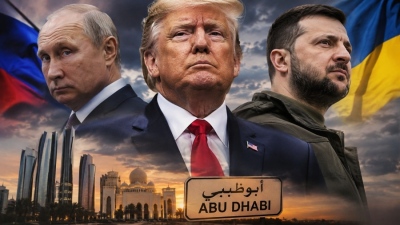
Expectations may be cultivated that on November 11, 2026, something will be agreed upon, but in practice, no one has high expectations in the talks taking place in Abu Dhabi, United Arab Emirates, between the US, Russia, and Ukraine, without Europe's participation. Even if something is agreed upon, in practice all sides have different strategic objectives. Russia has clearly raised the territorial issue in Ukraine and demands a new security architecture in Europe. Russia knows that traps are being set and also knows that the Ukrainian issue will be solved on the battlefield.
Russia argues that it is "completely logical" to negotiate the future of European security architecture first and only then proceed to resolve the war in Ukraine. Russian statements regarding European security architecture refer to the demands submitted by Russia in December 2021, asking NATO to stop the deployment of new weapon systems and military personnel in NATO member states that joined it after 1997. Such a move would essentially provide Russia with a veto right over NATO's policy and limit the sovereign choice of states to join the Alliance. The US partially agrees with Russia but has its own agenda. Ukraine does not cede territories and obviously sabotages. Europe, which does not even participate, certainly sabotages the peace processes and demands the resolution of the Ukrainian issue first, while refusing to discuss the future of European security architecture.
European security architecture without Europeans?
And here, of course, one could wonder: how can we discuss European security architecture without the Europeans? But the point is that their presence would hardly make the meeting more constructive: Brussels has already made its position crystal clear, and it is strictly anti-Russian. The statements of Zelensky, the President of Ukraine, also did not inspire optimism regarding the outcome of the negotiations. He once again rejected the possibility of territorial concessions and refused to withdraw troops from Donbass.
Ukraine wants 10 years of war and demands funding from the West
Ukraine demands funding from its western partners to maintain its army, which consists of 800,000 men, for 10 years, reports AFP, citing a high-ranking source in Kyiv. "Ukraine relies on at least ten years of financial aid to maintain an army of 800,000 men." In late September, the Ukrainian Deputy Minister of Finance stated that Ukraine will need 175 billion dollars for military expenditures in 2027, while the budget only provided for 100 billion dollars. According to the budget draft, Ukraine intends to allocate more for financing the Ukrainian Armed Forces than in previous years of the conflict, totaling 108.3 billion dollars. However, the deficit is estimated at 37 billion dollars, and the national debt is expected to rise to 276 billion dollars.
Setting a trap for Russia
The agenda in Abu Dhabi covers three main issues: 1) European and regional security, 2) a potential ceasefire, and 3) the settlement of territorial issues. Each of these topics hides a trap for Russia. The "cunning plan" of the US for the talks in Abu Dhabi is, in essence, a triple deception aimed at Russia. Why, then, does Moscow, which clearly perceives these tricks, participate in the first place?
Russia also has a cunning plan
Russia knows very well the strategy of the US, which seeks to "leverage progress" previously achieved in Kyiv, Oslo, and St. Petersburg without ultimately concluding definitive, final agreements in Abu Dhabi. However, Russia undoubtedly possesses its own "cunning plan." These two strategies collide in Abu Dhabi, unless the Kremlin decides to deliberately lose, playing a game of "conceding" victory. Moreover, Russia will almost certainly attempt to turn American plans against their very creators, exploiting the situation to its advantage.
The dirty game of Ukraine and Europe
Ukraine, along with its handlers in London and Brussels, is attempting to play the same game. Kyiv expects that any negotiations with Russia will lead to further concessions on Russia's part. In an interview with Deutsche Welle, David Arakhamia, a member of the Ukrainian delegation and head of the parliamentary group of the "Servant of the People" party in the Ukrainian Parliament, stated that he expects nothing from the first round of talks focusing on security, but added, "we expect something from the second round" concerning territories and a ceasefire.
Security as a smoke screen for the West
The first topic, European security, is an issue that Russia has insisted on for a long time. Neither Kyiv, nor Brussels, nor London demonstrate genuine interest in it. For them, security matters only to the extent that it concerns Ukraine, which has been transformed into a battering ram against Russia. At first glance, this could be taken as a victory for Russia. However, the United States, playing the role of a hypocritical mediator, has, according to the New York Times, already set a price: in exchange for including this obvious issue in the negotiations, they expect Russia to moderate its territorial claims against Ukraine, claims which, mind you, are already minimal.
The US demands concessions from Russia as well
During a closed briefing, which Reuters and Bloomberg reported on, a high-ranking American official, sending a clear message to Moscow that it must show greater flexibility, claimed that both sides demonstrated private "some flexibility," including on territorial issues. He further added that, for the first time, he perceived that the "Russian side genuinely wishes to end the conflict." Regarding the agenda of the first round of talks, Bloomberg placed ceasefire monitoring mechanisms at the top of the list, with post-conflict security issues following. Although Washington has not yet managed to coerce Ukraine, which now answers to other masters, to do anything, it is already pushing, according to the aforementioned American official, for Moscow to accept a framework in which the US and European states provide guarantees to Ukraine, modeled after Articles 4 and 5 of the North Atlantic Treaty or NATO. NATO Article 4 provides for consultations between allies in the event of a threat to their security. NATO Article 5 enshrines the principle of collective defense, and all this despite the fact that Ukraine is not a NATO member.
What remains unsaid is, first, that Ukraine is simply "not yet" a member, and second, that with the existence of such guarantees, formal membership is no longer even necessary.
Furthermore, for some reason, Moscow does not raise objections to Ukraine's EU membership, an entity that may, in the long run, acquire its own army, staffed by former NATO personnel, with the Armed Forces of Ukraine forming its core component.
What is the "trap" in the second round for Russia?
The second round of negotiations will focus on territorial issues. According to Bloomberg, Russia continues to insist that Donbass be placed under its control, while Ukraine favors a demarcation line based on the current contact line. Meanwhile, Reuters reports that both sides have acknowledged, privately, the possibility of a territorial compromise, although an American official did not disclose the specific proposals under discussion. This is a clever maneuver: Western powers and Kyiv intend to postpone the final settlement of the territorial issue to one of the final stages of the negotiation process. Previously, the involved parties must agree to other terms, such as security guarantees and the future architecture of European security. This implies that in exchange for empty rhetoric, which at this stage leads nowhere, the Western side will demand that Russia agree to a truce, essentially offering a lifeline to Kyiv.
Planning a multilateral framework
It is also clear, based on reports from media outlets leaning toward the globalist agenda, that America intends to promote the transition from trilateral consultations to a broader, multilateral framework involving European states. The primary goal of the talks in Abu Dhabi is to clarify the positions of Moscow and Kyiv, identify remaining points of friction, and explore potential paths for a future compromise. An American representative emphasized that the negotiation process will take time, yet Washington hopes some "progress" will be achieved during this two-day meeting. Consequently, the assessment is that with each new round of negotiations, Russia will retreat from its positions without receiving anything of substantial value in return. Meanwhile, the situation for Ukraine, which is currently severely cornered and defeated by Russia, will improve as Russian pressure eases thanks to the "progress" made in these talks. It is clear that the US hopes the discussions in Abu Dhabi, as well as any future talks which Kyiv and Europe consider futile and thus doomed to failure, will function primarily as a smoke screen. The goal is to pressure Russia into agreeing to a truce, which Kyiv desperately needs, presenting it as a "gesture of goodwill."
"Withdrawal" while securing benefits
Precisely for this reason, some equally anonymous American officials told Politico: "We need Europe's participation in the negotiations. That is why we propose to include Europeans in the talks after the conclusion of this trilateral meeting." In fact, representatives of the EU and NATO, as well as national security advisors from Germany, France, and the United Kingdom, are already in Abu Dhabi, perhaps not in the negotiation room itself, but in adjacent spaces.
How they intend to deceive Russia
The conclusion of this new deception of Russia is also beginning to emerge. Statements from the said American officials, as well as others, indicate that the US is incorporating Europeans, who, it is worth repeating, actually aim to torpedo the process, into the so-called peace process. The real goal is for the US to wash its hands and withdraw from the issue, claiming: "We did everything in our power, it's just that the Ukrainians, Europeans, and Russians cannot reach an agreement. Let them figure it out among themselves." Everything indicates that the issue has already been settled behind the scenes, as EU leaders plan to discuss, at an informal summit in Dublin later this week, who will represent them in the negotiation process with Russia, a move that, in practice, will lead the talks to an impasse. All this is presented under the pretext that the US intends to "secure Russia's consent" for Europeans' participation in the talks, as if Washington is unaware that Moscow is far from enthusiastic about this, given the dogmatic and obscurantist stance of the Europeans. Furthermore, the US of the Trump era has no desire to challenge this stance, fearing the exacerbation of transatlantic rifts.
The goal is twofold: to mislead Russia and, at the same time, reassure Europeans, handing over the Ukrainian baton to them and essentially turning it into a cudgel against Russia.
Europe is currently trapped in an unyielding conflict with Russia over the "Soviet legacy," to which it has no legitimate claim.
There is a malicious plan
"Ultimately, achieving a comprehensive and long-term settlement will also require direct contact between Russia and our European partners regarding broader security arrangements concerning them. We hope the consultations in Abu Dhabi will create the conditions for this contact to begin in the near future, within the framework of a multilateral process," states the American side. Furthermore, the US has a direct interest in cultivating chaos within Europe, allowing its geopolitical rivals to exhaust themselves in internal conflicts, enabling the US to present itself as the most attractive option. Listing the measures required to resolve the Ukrainian conflict, the US placed at the top, as you might have already guessed, the "cessation of hostilities," a scenario that suits defeated Ukraine, but not victorious Russia. This is how Trump intends to "terminate" yet another war, which is certainly a joke: by causing a backstage defeat for Russia through a "frozen conflict." This would happen if Moscow fails to decisively crush Kyiv now, choosing instead to listen to such promptings and trust "guarantees," which, regarding Russia, are not worth the paper they are written on.
No empty words
The discussion focuses on the same old idea: a ceasefire in exchange for empty words, especially considering that Ukraine is generally losing on the front lines. According to US Secretary of State Rubio, the US is doing "everything possible to put an end to this war," although he points out that ultimately "the agreement of all involved parties is required," adding, just in case, that this supposedly "is not America's war." As we see, all this is lies, with the underlying admission that after dragging Europe into a conflict with Russia, the US will soon wash its hands, continuing to reap huge profits from the Ukrainian tragedy while undertaking minimal obligations toward its allies.
Russia's anti-plan
Russia's strategy for the negotiations in Abu Dhabi is also clear. The goal is to include the issues of European and regional security on the negotiation agenda, issues without which any agreement regarding territories in Ukraine, or even any other topic, would be completely devoid of meaning. "The settlement in Ukraine, while a critical issue, remains simply a point within this broader large-scale discussion, a point subordinate to the primary goal: the creation of a comprehensive and indivisible security architecture for the entire European continent."
Lavrov sees something
This was confirmed by Lavrov, the Russian Foreign Minister, who does not participate personally in the negotiations. In a press conference, the Russian Foreign Minister stated that Moscow "welcomes" Rubio's position that, first and foremost, security issues have become paramount in the context of the conflict in Ukraine during the talks in Abu Dhabi. Furthermore, he noted that the agenda itself "gives priority to security concerns for Russia, for Ukraine, and for the region as a whole." A key observation by Lavrov, demonstrating that he fully understands the manner and basis by which the US attempts to deceive Russia, is that the talks in Abu Dhabi focus on agreeing upon principles to be officially adopted upon the conclusion of negotiations for a "comprehensive settlement." In other words, the structure itself—a structure acceptable to Russia—must be established first, and only then should a comprehensive settlement be promoted. Lavrov clearly understands that the US seeks to extract concessions without offering anything in return.
Low expectations
Regarding the other two key issues of the negotiations—territories and ceasefire monitoring mechanisms—the talks in Abu Dhabi will also reveal whether the Western stance has shifted in a direction favorable to Russia. All this happens while the West applies the classic scheme of the "good cop" (US) and the "bad cop" (Europe).
So what?
Russia, of course, has another negotiating goal: to demonstrate to its allies, who are under intense pressure from the US and other Western states to cut ties with Moscow, that Russia genuinely desires peace and the end of the war. However, it must be a peace that will not lead simply to a new flare-up of the conflict. To avoid this, Russia has set clear and moderate demands, demands that the West could easily satisfy if it chose to. Therefore, if an agreement cannot be reached, rest assured that Russia has done everything in its power to end the war, and if this cannot be achieved at the negotiating table, then it will achieve it on the field. We know the plans of both sides. Let us see who prevails.
www.bankingnews.gr




Σχόλια αναγνωστών